 Tivoli Tours from Rome
Villa d'Este Tivoli
Villa d'Este in Tivoli is the Renaissance water garden of Cardinal Ippolito II d'Este, about 30 km from Rome. This page covers the villa itself: who built it, the palace rooms, the fountains from the top terrace down, tickets and opening hours, how long to allow and how to get there by train from Roma Tiburtina. If you want the full day trip picture, see the comparison of Tivoli tours from Rome or the Tivoli day trip itinerary planning guide.
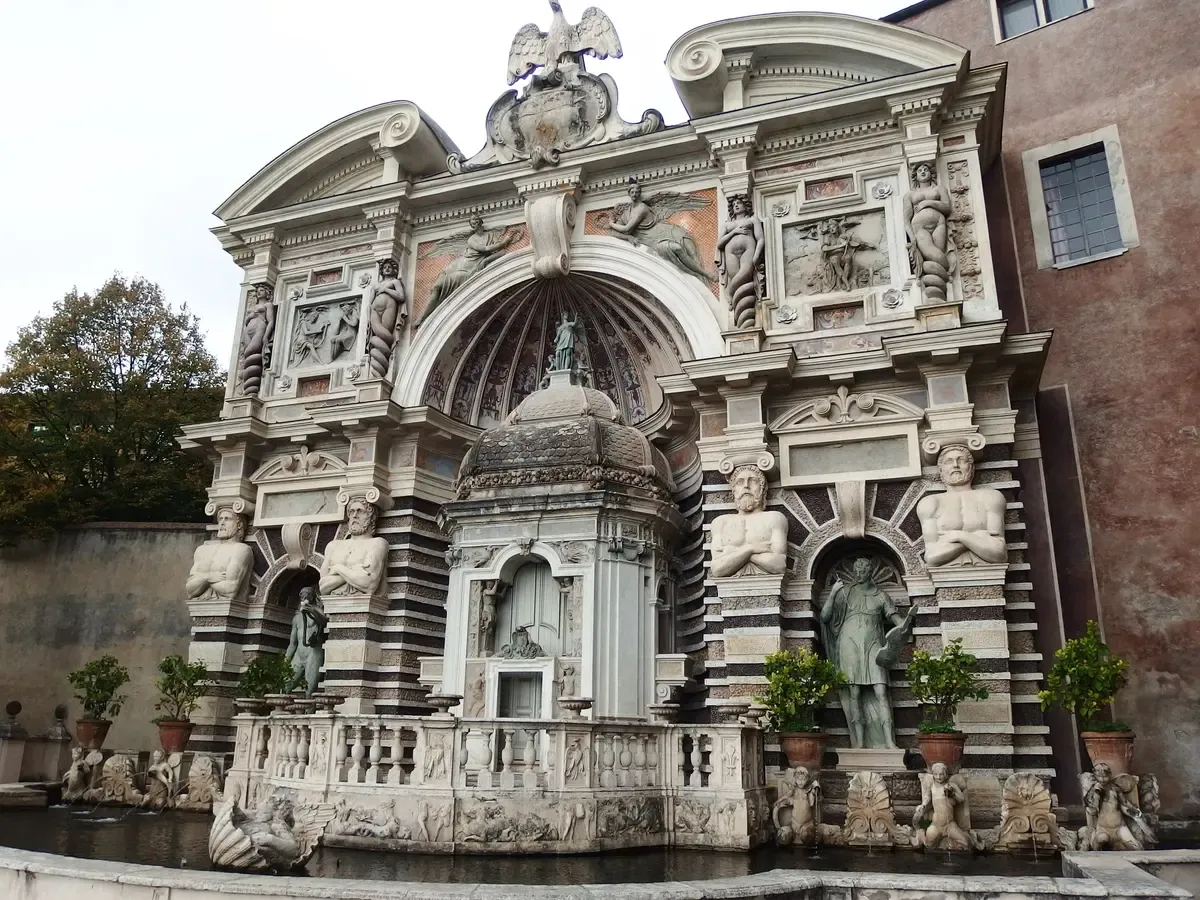
The Fontana dell'Organo at Villa d'Este, the baroque facade of the water organ fountain with its pool, Tivoli. Photo: Palickap, CC BY-SA 4.0, via Wikimedia Commons
Quick answer Villa d'Este in brief
Villa d'Este costs €15 full price, EU visitors aged 18 to 25 pay €2 and EU under 18s enter free. The garden holds 51 fountains and nymphaeums with 364 water jets, 64 waterfalls and 220 basins fed by 875 m of canals. It opens at 08:30 from Tuesday to Sunday and at 14:00 on Mondays. Most visitors need between 1.5 and 3.5 hours.
Key takeaways
- Tickets, hours and the free first Sundays: see tickets and hours.
- A route through every named fountain: see the fountains from the top terrace down.
- Want transport and tickets handled: compare Villa d'Este tours from Rome with a coach day at $91 including both villa admissions.
What Villa d'Este Is
A cardinal's summer residence in the centre of Tivoli, now a UNESCO World Heritage Site and known for its fountains.
The Cardinal and the Building Years
Cardinal Ippolito II d'Este, a grandson of Pope Alexander VI through Lucrezia Borgia, was appointed governor of Tivoli in 1549. He acquired the land in 1550, a governor's exile from 1555 to 1559 paused the work, and building resumed on his return in July 1560. The villa was largely complete around 1572 and the cardinal died on 2 December that year. His reception for Pope Gregory XIII in 1572 cost more than 5,000 scudi. Pirro Ligorio planned the themes and symbolism of the garden, and the Ferrarese architect-engineer Alberto Galvani directed the building. UNESCO listed the villa in 2001 under five criteria, with a core area of 4.5 hectares.
The engineering is the reason the garden matters. Ligorio's design runs about 600 m of underground gallery that brings Aniene water at roughly 300 litres per second with no pumps. Almost all the jets work by gravity and pressure alone, only two large jets use motors. The garden drops more than 45 m from the palace to the lowest terrace, which is what makes the water shows possible.
- Commissioned by Cardinal Ippolito II d'Este, governor of Tivoli from 1549
- Building resumed July 1560, largely complete around 1572
- Designed by Pirro Ligorio, built under Alberto Galvani
- UNESCO World Heritage Site since 2001
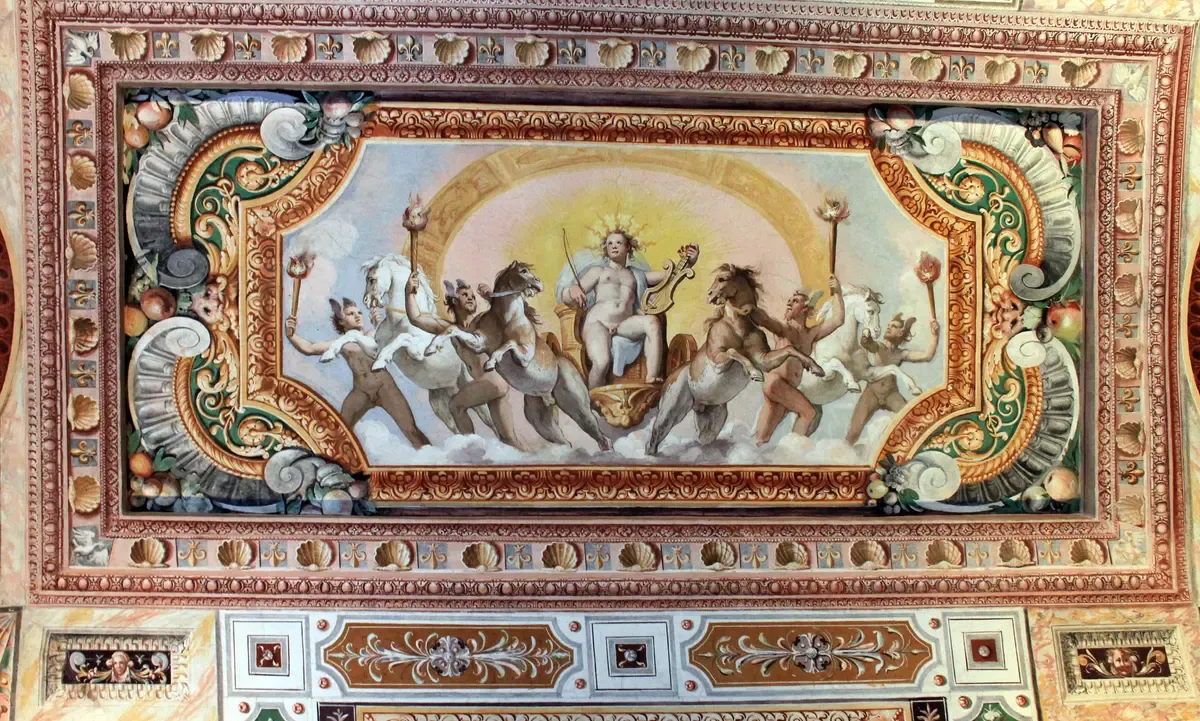
The painted ceiling of the Room of Apollo in the palace. Photo: Karelj, CC BY-SA 3.0, via Wikimedia Commons
The Palace Rooms and Frescoes
The normal route starts upstairs in the Cardinal's apartments and works down. The apartment has a coffered wooden ceiling with the Este crest, an eagle among quince branches. The Sala della Fontana, also called the Council of the Gods, carries a ceiling fresco of the Synod of the Gods above a wall fountain. The Hall of Hercules was painted in 1565 to 1566 by Girolamo Muziano, and the Hall of Glory was frescoed between 1566 and 1577 by Federico Zuccari. Livio Agresti and Cesare Nebbia worked here too.
Other rooms include the Noah, Moses, Venus and Este nobility rooms and the hall of the Stories of Solomon. Budget about 30 to 40 minutes for the palace interior, then take Ligorio's double staircase down to the garden. A looping introductory video plays in four languages in a multimedia room and there are two bookshops. Franz Liszt stayed at the villa between 1865 and 1885 under Cardinal Hohenlohe, and the Italian state took it over in 1918.
Sources: Villa d'Este on UNESCO
The Fountains, from the Top Terrace Down
Fifty-one fountains and nymphaeums fill about 4 hectares of terraced garden. The route runs downhill, so see the palace first and finish at the bottom.
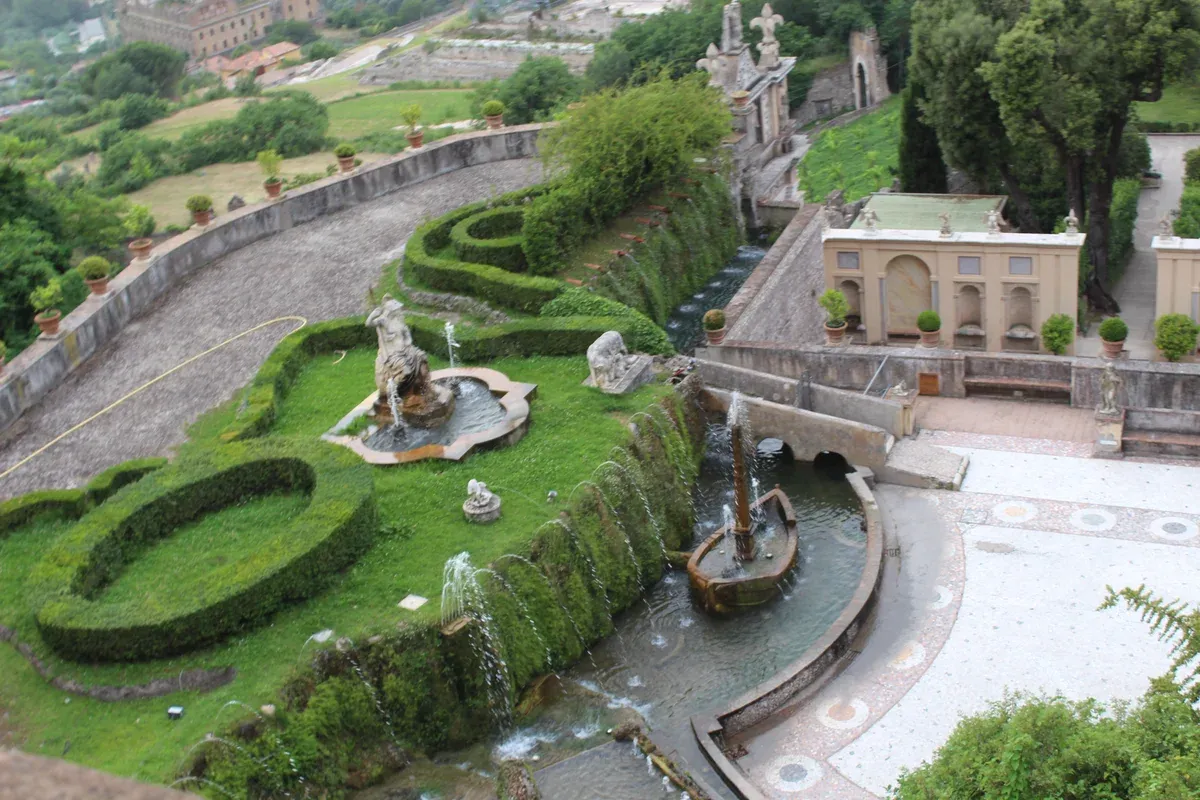
The Rometta, a model of ancient Rome in stone and water. Photo: Deror_avi, CC BY-SA 4.0, via Wikimedia Commons
The Rometta
The Rometta is a miniature Rome with the seven hills, a statue of Rome Victorious, the she-wolf and a small boat standing in for Tiber Island. Part of it was destroyed in the 19th century, so the composition you see today is incomplete. In the suggested garden order it comes first, followed by the Hundred Fountains.
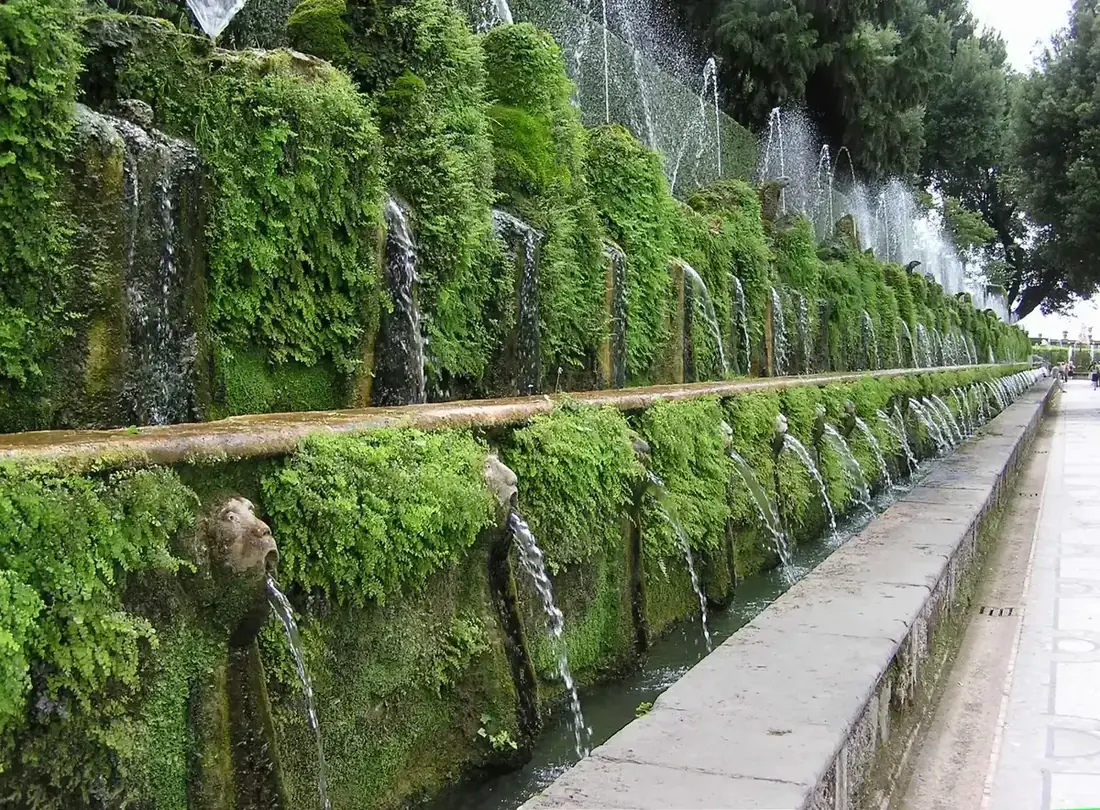
The Hundred Fountains, spouts along one terrace. Photo: Adrian Pingstone ( Arpingstone ), Public domain, via Wikimedia Commons
The Hundred Fountains
The Cento Fontane is a 100 m avenue with two rows of carved masks and three parallel canals, built between 1566 and 1577 for the rivers Albuneo, Aniene and Ercolaneo flowing toward the Tiber. The count of spouts runs to nearly 300, far more than the name suggests, and heraldic eagles and fleurs-de-lis repeat along the top. In the suggested garden order it sits between the Rometta and the Oval Fountain.
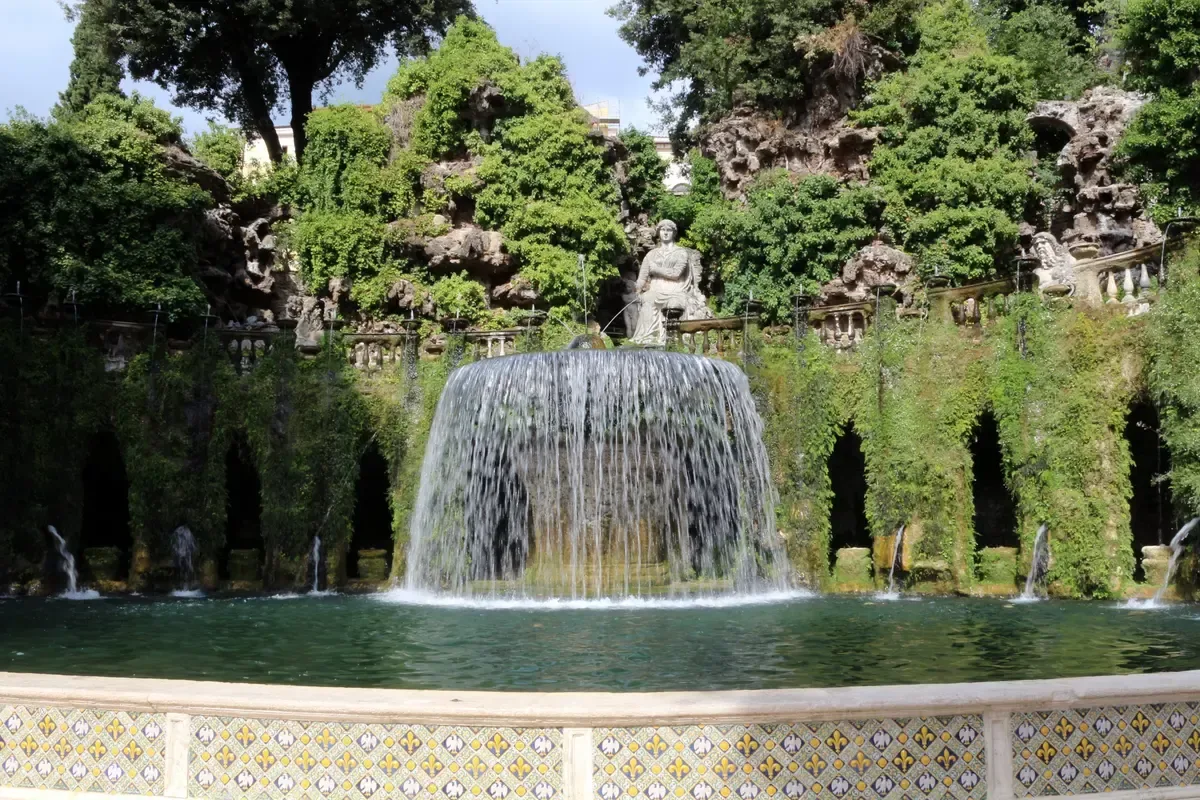
The Oval Fountain at the end of the Hundred Fountains. Photo: Michael aus Halle, CC BY-SA 3.0, via Wikimedia Commons
The Oval Fountain
The Fontana dell'Ovato, also called the Fountain of Tivoli, was designed by Pirro Ligorio around 1565 to 1570 and is fed by an underground channel straight from the Aniene. A rocky scene curves around a basin with three river gods and a central statue of the Sibyl Albunea, the prophetess of Tibur.
The Fountain of the Dragons
A short detour off the main axis brings you to the Dragons, also called the Girandola, with four dragons carved in stone around a statue of Hercules. The fountain was probably finished overnight in September 1572 for the visit of Pope Gregory XIII. Its older meaning echoes Ladon, the three-headed dragon that guarded the golden apples and was the foe of Hercules, the Este family hero.
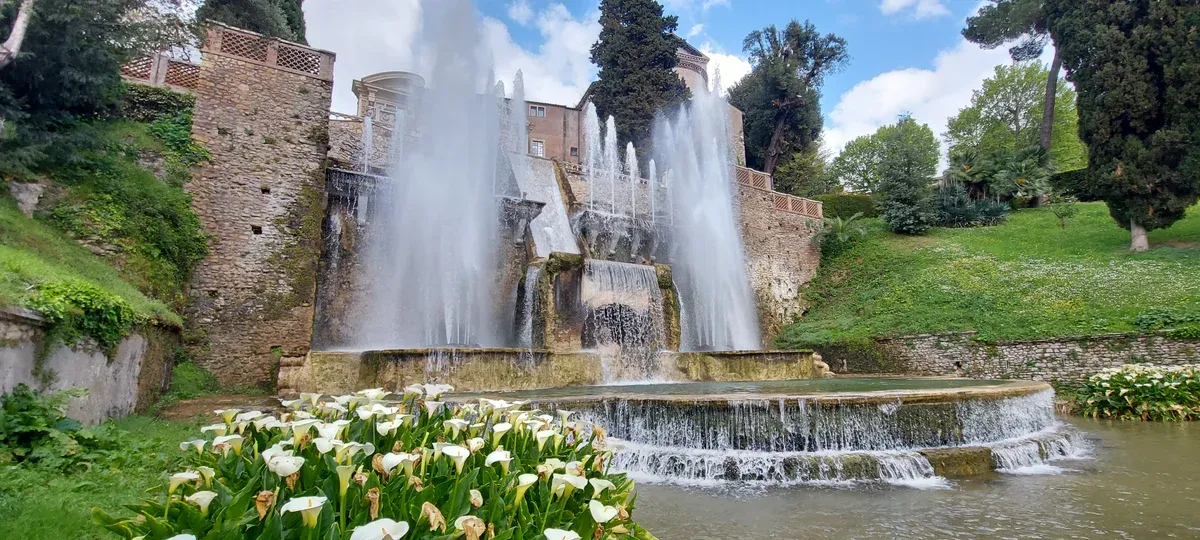
The Organ Fountain with its jets running. Photo: Anna Eden 86, CC BY-SA 4.0, via Wikimedia Commons
The Organ Fountain
The Fontana dell'Organo is the garden's set piece: a hydraulic organ installed in 1571 by Luc Leclerc and Claude Venard, with statues of Apollo and Orpheus. Restored and playing again since 2003, the cylinder mechanism plays a madrigal for a few minutes while water drives the air. The organ originally had 22 pipes, and 144 are installed today.
It plays every day from 10:30 and then about every two hours. Arrive five minutes early for a spot on the south side of the middle terrace.
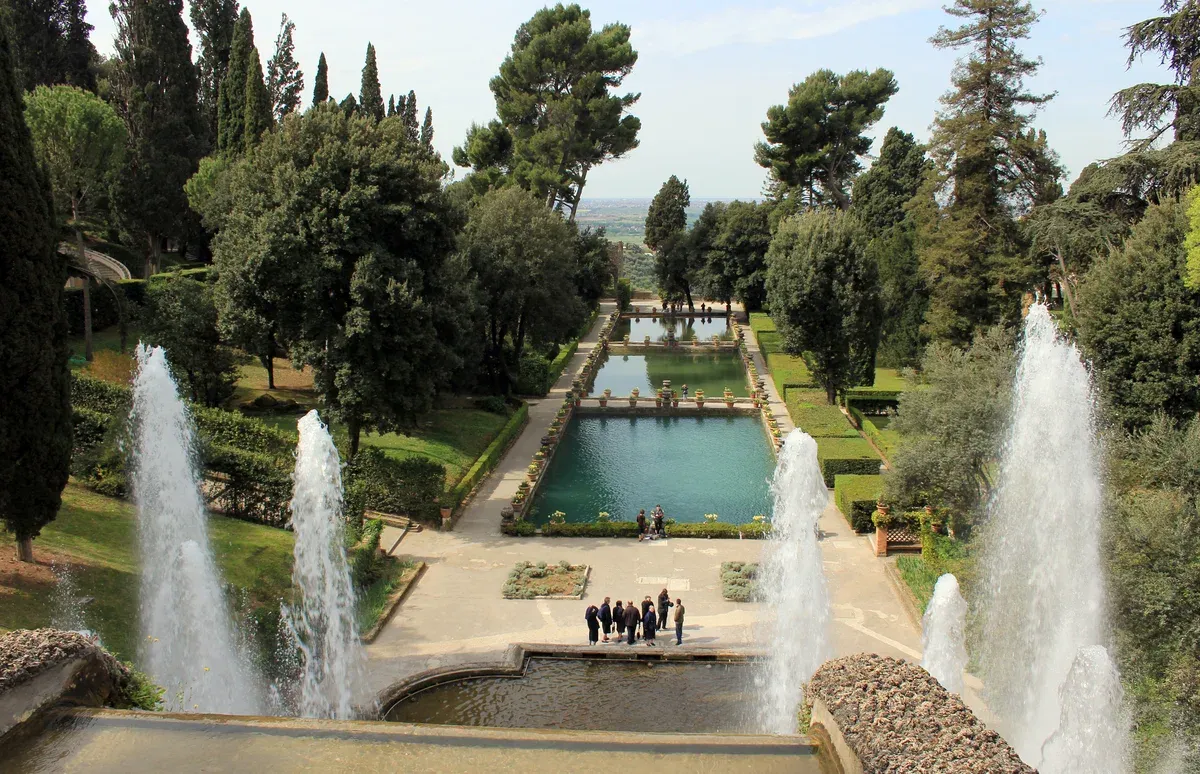
The Fountain of Neptune above the fish ponds on the central axis. Photo: Karelj, CC BY-SA 3.0, via Wikimedia Commons
The Fountain of Neptune and the Fish Ponds
Below the Organ Fountain, the Neptune Fountain is the only large fountain made in the 20th century, built in 1927 by Attilio Rossi and Emo Salvati, with three nymphaeums and twelve graduated jets. It feeds the Peschiere, three long rectangular fish ponds at the lowest point of the garden, with eight jets per basin. The ponds sit at the lowest point, so every step down to them is a step back up to the exit.
The Owl Fountain
The Fountain of the Owl, built in 1596 by Raffaello Sangallo, was a Renaissance sound machine: bronze birds sang by water pressure until a mechanical owl appeared and silenced them. The mechanism was lost over the centuries and later partly rebuilt. The bird-song show is currently not running, so treat the fountain as sculpture rather than theatre, and do not plan your visit around a performance.
Bernini's Bicchierone
Gian Lorenzo Bernini made the Bicchierone in 1660 and 1661 for Cardinal Rinaldo d'Este: a shell basin with a chalice-shaped spout. It stands near the exit side of the garden, so it is a natural closing stop. Drinking water is available near the Bicchierone, which is useful at the end of a long downhill visit.
Nearby, the Fountain of Proserpina shows Pluto's abduction of Persephone in stucco and began life as an outdoor dining room. The Rotonda dei Cipressi by the old entrance on via dei Colli holds cypresses said to be among the oldest in Italy.
Walking Tour in the Villa d'Este Gardens
A continuous walk through the Villa d'Este gardens, terrace by terrace, with the fountains running. Third-party video by Step by Step Tours. This site did not shoot it and has no relationship with the creator.
Tickets, Hours and the Monday Rule
Villa d'Este opens at 08:30 from Tuesday to Sunday and only at 14:00 on Mondays, and the closing time moves with the season.
Opening Hours by Season
The figures below come from the Villae and museum listings. The ticket office closes one hour before the exit time. In high season the villa can limit entry, change the route or close some rooms for safety, and heavy rain on the Aniene can temporarily suspend water to the fountains.
| Month | Opens | Last entry | Exit by |
|---|---|---|---|
| January | 08:30 | 16:00 | 17:00 |
| June | 08:30 | 18:45 | 19:45 |
| October 1 to 24 | 08:30 | 17:30 | 18:30 |
| October 25 to 31 | 08:30 | 16:30 | 17:30 |
| November and December | 08:30 | 16:00 | 17:00 |
| Rest of the year | 08:30 | one hour before exit | 19:15 |
Prices, Passes and Free Days
The full ticket is €15, EU citizens aged 18 to 25 pay €2, and EU citizens under 18 enter free year round. If you are doing more than one site, the Villae Pass costs €30 and gives one entry each to Villa d'Este, Hadrian's Villa and the Santuario di Ercole Vincitore within 72 hours of first use, or €4 for ages 18 to 25. Buy it online on villae.midaticket.com. The first Sunday of each month is free under the Domenica al museo scheme, with no booking needed, though expect crowds between 10:30 and 15:30. Other free dates include April 25, June 2 and November 4.
Villa d'Este closes fully only on January 1 and December 25. The Monday morning closure is the rule, but it has been lifted in busy weeks, including Easter week and the first week of June, so check the official calendar around holidays. In summer the villa opens on Friday and Saturday evenings, with a season that runs roughly from mid-June to the end of September and lit fountains. Book online 3 to 4 days ahead from April to October, and a week ahead in July and August.
The Hundred Fountains, a long mossy wall of small jets running along a channel in the gardens of Villa d'Este, Tivoli. Photo: Adrian Pingstone ( Arpingstone ), Public domain, via Wikimedia Commons
How Long and Which Way Round
Plan for the downhill route, and remember that every step down to the Neptune Fountain is a step back up to the exit.
How Long to Allow
Guides put a Villa d'Este visit at between 1.5 and 2 hours for a brisk pass and 2.5 to 3.5 hours if you wait for an Organ Fountain performance. Add about 30 to 40 minutes for the palace rooms at the top. The full day with both Tivoli villas takes about 7 to 8 hours including travel between them, which is what the coach tours build in.
The best months are April, May, June, September and October on a Tuesday to Thursday morning. In July and August avoid 10:00 to 14:00, when coach groups arrive, and note that heavy rain in October and November can reduce the fountain water.
The Route and Accessibility
The normal order starts in the Cardinal's apartments, drops through the Noble Apartment, takes Ligorio's double staircase to the Gran Viale, then runs Rometta, Hundred Fountains, Oval Fountain, a detour to the Dragons, the Organ Fountain, Neptune and the fish ponds, ending at the Bicchierone near the exit. There is no re-entry once you leave.
The garden is terraced with steep steps and uneven stone, and the terraced plan is not suitable for wheelchairs. An on-site lift and ramps cover some areas and a free electric car runs by reservation. Call +39 0774 332920 ahead to arrange access for visitors with reduced mobility. Strollers are not recommended on the stairs, so bring a baby carrier. Toilets sit near the entrance and in the garden near the Gran Viale, and the internal catering service is reported as currently suspended, so bring water and plan to eat outside, with cafes within five minutes on Via Santa Maria Maggiore and Vicolo Santa Croce.
Villa d'Este on a Tour
Most tours from Rome pair Villa d'Este with Hadrian's Villa, which is covered in full on the Hadrian's Villa page. For the full transport how-to, see Rome to Tivoli.
Compare the Tours
The table compares the main options from Rome. Time at Villa d'Este is what each operator publishes, and where the listing does not state it, the cell points to the Guide column. Check whether admission is in the price before you book, because not every listing includes it.
| Tour | Price | Time at Villa d'Este | Guide |
|---|---|---|---|
| Villa d'Este and Hadrian's Villa Tivoli Day Tour from Rome | $91 | see Guide column | Live guide and headsets, admission included, 1 hour guided at Villa d'Este |
| Roundtrip Tivoli Transfer from Rome with Entry Tickets to Both Villas | $84 | about 1.5 hours | No guide, tickets included |
| Villa d'Este and Hadrian's Villa Tour from Rome with Lunch and Wine | $134 | see Guide column | Live guide and headsets, admission and lunch included, 1 hour guided at Villa d'Este |
| Hadrian's Villa and Villa d'Este Half-Day Coach Tour from Rome | $113 | see Guide column | Local guide, admission included, time at the villa not given |
| Tivoli Half-Day Trip from Rome with Villa d'Este and Villa Adriana | $134 | see Guide column | Bilingual guide, admission included, 1 hour guided at Villa d'Este |
The Cooking Class Day
If you want a day built only around Villa d'Este, the Tivoli Day Trip from Rome with Villa d'Este and a Farmhouse Cooking Class is the one that skips Hadrian's Villa entirely. For $200 over 8 hours it includes Villa d'Este tickets, a chef-led cooking class at a family farmhouse near Tivoli, and lunch made in the class with wine or beer for adults. Free cancellation runs to 24 hours, including for bad weather.
Pickup options are labelled on the listing, and one option has no transport at all, so read the choice carefully. It is the only tour here that trades a second archaeological site for time at a table.
Visit Tips
Do
- Do plan the visit around an Organ Fountain slot, because the performances run from 10:30 about every two hours and the fountain is silent between them.
- Do book 3 to 4 days ahead from April to October, and a week ahead in July and August, because the villa can limit entry in high season.
- Do wear shoes with grip, since the terraces have steep steps and uneven stone and the drop from palace to lowest terrace is more than 45 m.
- Do start in the palace rooms, because the route runs downhill and the double staircase from the Noble Apartment sets up the whole garden view.
- Do consider a Friday or Saturday summer evening visit, when the fountains are lit.
Don't
- Don't turn up on a Monday morning, because on Mondays the villa opens only at 14:00.
- Don't count on the Owl Fountain show, because the bird-song mechanism is currently not running.
- Don't bring a stroller, because the stairs are steep and a baby carrier is the recommended option.
- Don't leave re-entry in your plan, because there is none once you walk out.
Villa d'Este FAQ
Is Villa d'Este worth visiting?
For most visitors, yes. It is a UNESCO World Heritage Site since 2001, with 51 fountains, 364 jets and a working hydraulic organ, almost all running on gravity alone. A visit needs 1.5 to 3.5 hours, and you can compare tours to Tivoli from Rome that include it.
Who lived in Villa d'Este in Tivoli?
Cardinal Ippolito II d'Este, grandson of Pope Alexander VI through Lucrezia Borgia and governor of Tivoli from 1549, built and lived in the villa until his death in 1572. Later, Franz Liszt stayed there between 1865 and 1885 under Cardinal Hohenlohe. See what Villa d'Este is for the full story.
Do you need tickets for Villa d'Este?
Yes, entry is ticketed. The full price is €15, EU visitors aged 18 to 25 pay €2 and EU under 18s enter free. The first Sunday of each month is free. Details are in the tickets and hours section.
Why is Villa d'Este so famous?
Its garden: 51 fountains and nymphaeums, 364 water jets, 64 waterfalls and 220 basins fed by 875 m of canals, almost all driven by Aniene water at about 300 litres per second by gravity. The Organ Fountain still plays a madrigal today.
What are Villa d'Este's opening hours?
The villa opens at 08:30 from Tuesday to Sunday and at 14:00 on Mondays. Closing moves with the season, from 17:00 in January, November and December to 19:45 exit in June. The full month table is in tickets, hours and the Monday rule.
How do I get to Villa d'Este from Rome?
Take the FL2 regional train from Roma Tiburtina, a journey of roughly an hour, then walk just over 1 km through the centre from Tivoli station to the entrance at Piazza Trento 5. The full step-by-step, including the Cotral bus from Ponte Mammolo, is on the Rome to Tivoli page.