 Tivoli Tours from Rome
Hadrian's Villa Tivoli: The Complete Guide to Visiting Villa Adriana from Rome
Hadrian's Villa (Villa Adriana) is a major ancient site near Rome and the reason many travelers book Tivoli tours from Rome. Emperor Hadrian built it as a country residence outside Tivoli, and today about 40 hectares are open to walk among pools, baths and ruins. This page covers what you see inside, tickets and hours, how to get there from Rome, and which tours include it. If you want the Renaissance villa with the fountains instead, that is covered on the Villa d'Este page.
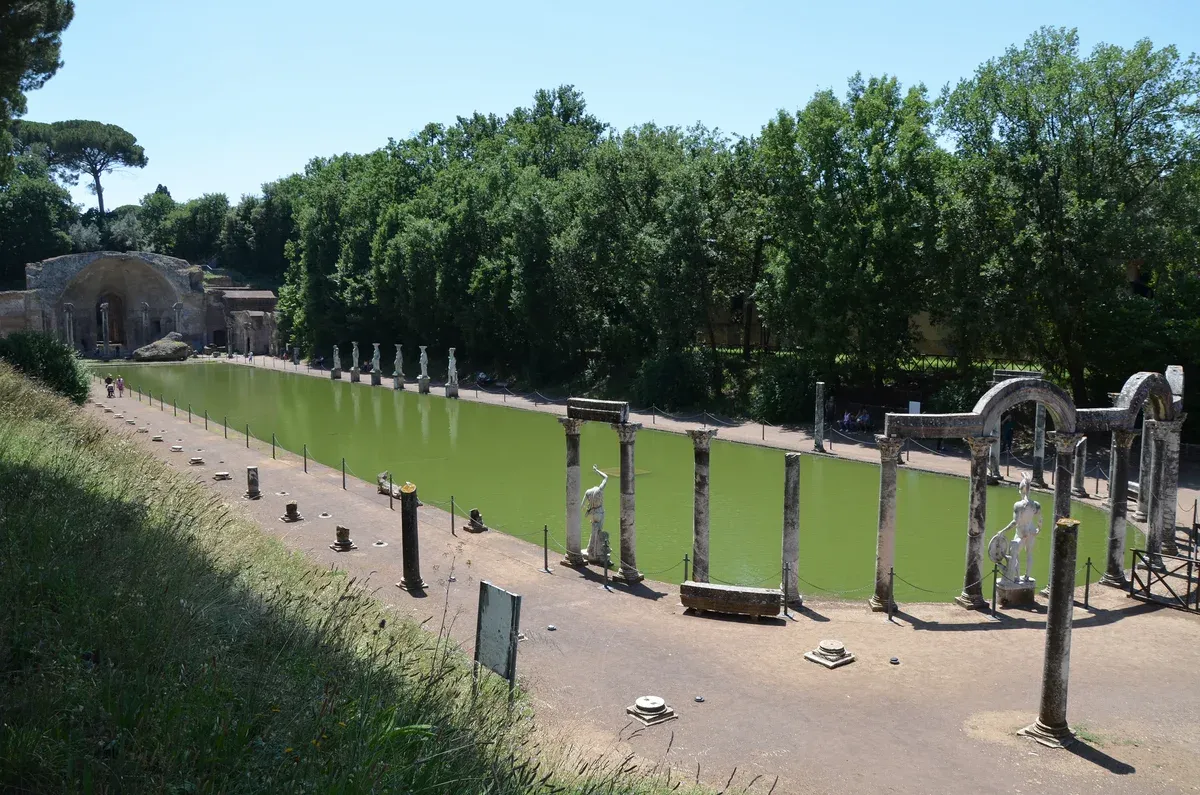
The Canopus pool with its colonnade and statues at Hadrian's Villa. Photo: Carole Raddato from FRANKFURT, Germany, CC BY-SA 2.0, via Wikimedia Commons
Quick answer Hadrian's Villa in one minute
Hadrian's Villa (Villa Adriana) is Emperor Hadrian's ruined country residence near Tivoli, about 30 km from Rome. About 40 hectares of the roughly 120 hectare estate are open to visitors, and a quick visit takes 2 to 3 hours, with 3 to 4 hours for the full route. The site sits about 4 km below Tivoli town, reached by CAT bus 4 or 4X from Tivoli or by Cotral from Rome.
Key takeaways
- Entry is covered by the Villae Pass at €30, which also covers Villa d'Este and the Santuario di Ercole Vincitore for 72 hours. See tickets and hours.
- From Rome you can take the FL2 train to Tivoli and then CAT bus 4 or 4X, or a Cotral bus from Ponte Mammolo. The full how-to is on the Rome to Tivoli page.
- Prefer someone else to drive? The Villa d'Este and Hadrian's Villa Tivoli Day Tour from Rome includes coach travel, entry to both villas and a guide for $91.
- For a walking order through the ruins, from the scale model to the Canopus, see the route section.
What Hadrian's Villa Is
Villa Adriana was the private country residence of Emperor Hadrian. It has been on the UNESCO World Heritage list since 1999.
An Emperor's Country Palace
Publius Aelius Hadrianus reigned from 117 to 138. Work on his Tivoli retreat began at the end of 118 or the start of 119, and Hadrian made the villa his official residence around 128. Building ran into the late 130s, and brick stamps from the South Theatre are dated to 137, so some parts were probably unfinished when he died in 138.
Scholars count three main building phases, around 118-121, 126-127 and 134-138. This is not a small summer house. It is a government seat in the countryside, with its own baths, libraries, service tunnels and accommodation for a full imperial court.
How Big It Is, and Why It Matters
The estate covers about 120 hectares, of which roughly 40 hectares are open to visitors, with more than 30 buildings counted. Wikipedia puts the whole complex at at least one square kilometre, larger than the city of Pompeii, and much of it is still unexcavated with large peripheral areas in private hands. Hadrian filled it with reconstructions of places he had seen on his travels: the Pecile recalls a painted stoa in Athens, the Canopus recalls the canal of Alexandria on the Nile.
UNESCO listed the site in 1999 with a core area of 80 hectares. Cardinal Ippolito II d'Este stripped much of the remaining marble and statuary in the 16th century to decorate Villa d'Este in town. Piranesi and Renaissance architects drew the ruins, and their plans are shown at the site today.
Sources: Wikipedia, Archeoroma
Walking the Site: What You See, in Order
There is no single mandatory path, but most visitors follow roughly the same loop from the entrance. Plan 2 to 3 hours for the quick version and 3 to 4 hours for the full visit. The order below follows the way the site is usually walked,.
The Scale Model Near the Entrance
Start at the plastico, the large scale model of the villa displayed near the entrance, because the typical visit starts there. Standing over it for five minutes is the fastest way to understand what you are about to walk through. The model shows the whole estate with its pools, theatres and bath blocks, and it makes clear how much of the site is foundations and low walls rather than standing buildings.
Without this orientation, the ruins can read as scattered fragments. Photograph the model, note where the Pecile, the Maritime Theatre and the Canopus sit in relation to each other, and you will not need to consult a map at every corner later.
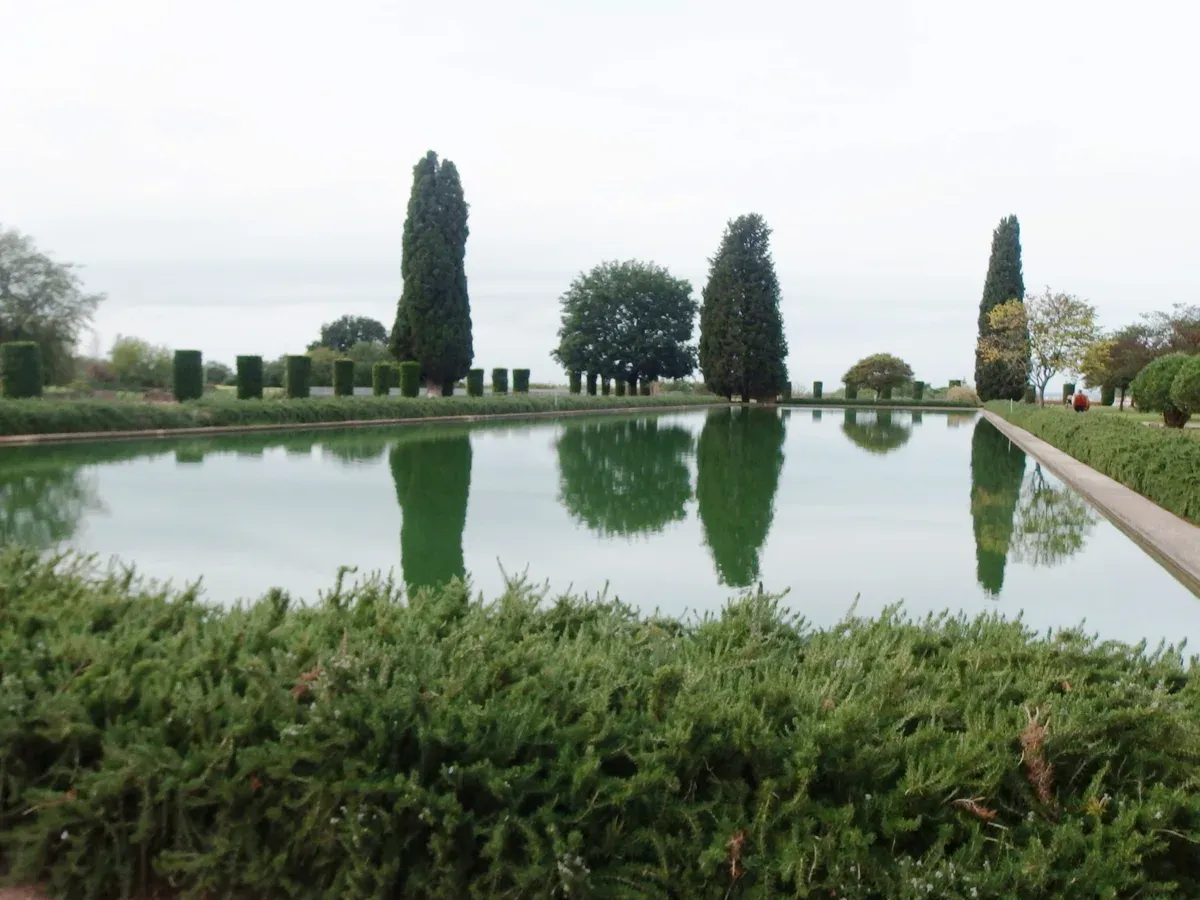
The Pecile pool, with the long brick wall that once carried a covered walk. Photo: Palickap, CC BY-SA 4.0, via Wikimedia Commons
The Pecile
The Pecile is usually the first stop after the model, and it is one of the most impressive. It is a huge rectangular enclosure modelled on the Stoa Poikile of Athens, with a basin of 232 by 97 metres and a colonnade around it. A 9 metre high spine wall splits the portico into two walks, one facing north for summer shade and one facing south for winter sun, an early piece of passive climate design.
One lap of the spine is 430 metres, and ancient writers counted seven laps as 2 Roman miles of healthy exercise.
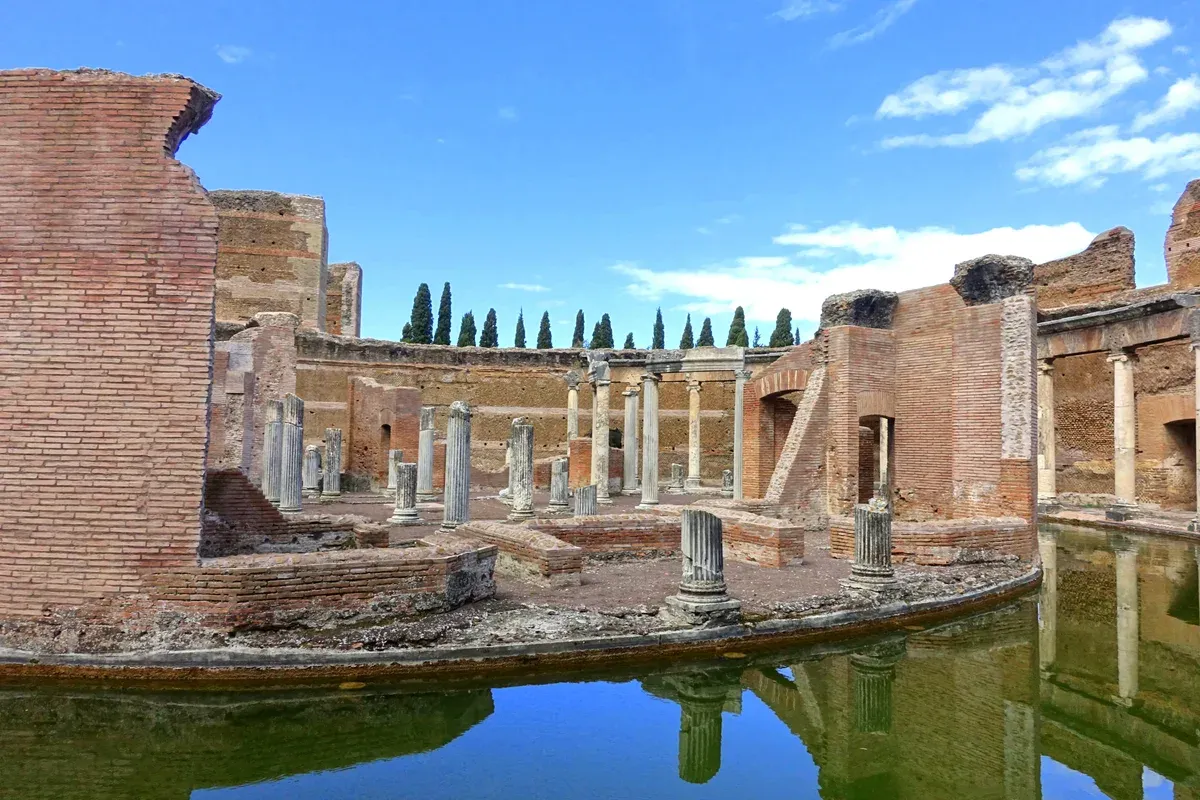
The Maritime Theatre, an island villa ringed by a moat and a colonnade. Photo: Daderot, Public domain, via Wikimedia Commons
The Maritime Theatre
The Maritime Theatre (Teatro Marittimo) is one of the best-known structures at Hadrian's Villa. It is a circular portico, about 40 metres across, enclosing a ring-shaped pool with a small island at the centre. On the island stands a miniature palace of rooms arranged around a tiny courtyard, reached in antiquity by two wooden drawbridges that could be pulled away.
It was one of the first structures built, from about 118, and is widely read as Hadrian's private retreat inside the retreat. The island was closed for decades and reopened to visitors in 2017 after restoration, so check on the day whether access to the island itself is allowed.
The Hall of Philosophers
The Sala dei Filosofi is a vast vaulted hall whose purpose is debated. Its domed apse has seven rectangular niches and its walls were once lined with alabaster, marble and red porphyry, which tells you this was no storehouse. Guides link the name to a library or a hall for learned conversation, fitting a villa that also had Greek and Latin libraries.
Whatever it was for, the scale is the point: the hall is one of the biggest covered spaces on the site, and standing in it gives a feel for the engineering behind the vaults. Note that during private events this hall, together with the Maritime Theatre and the Great Baths, can be closed at short notice.
Hadrian's Own Baths (Heliocaminus)
The Small Baths (Piccole Terme) and the baths with the Heliocaminus room show the private side of the villa. The Heliocaminus, begun about 118, is an early and innovative sunlight-heated caldarium, a domed room with window openings that let the sun do the work of the furnace. The Small Baths were reopened to visitors after conservation works, together with the Hospitalia block nearby, which has a central corridor with five rooms on each side, T-shaped rooms with three alcoves, mosaic floors and two communal latrines.
These blocks housed staff and guests. Looking at the floor mosaics and the service passages here shows how much space the villa gave to staff and guests.
The Libraries, Imperial Palace and Piazza d'Oro
The Greek and Latin Libraries surround a courtyard, and in 1881 a cache of 2,672 silver coins was found under the stairs of the Latin Library. Next to them lies the Imperial Palace, the largest residential complex, where the court lived. Close by, a field shaded by centuries-old olive trees offers benches and a water fountain, the best rest spot on a hot day since shade is scarce across the whole site.
The Piazza d'Oro (Golden Square) follows: a peristyle of 61 by 51 metres with an octagonal vestibule once covered by an umbrella dome and a nymphaeum wall of seven niches. The name suggests the richness of its former decoration, and the curve of the octagon room is still clearly readable.
The Cento Camerelle and the Antinoeion
Two structures worth a short detour lie on the slopes between the main buildings. The Cento Camerelle, the Hundred Rooms, is a huge substructure of identical small rooms stacked on up to four floors, built to even out a height difference of up to 15 metres in the hillside. From outside it looks like a Roman apartment block sunk into the ground.
The Antinoeion, found in 1998, is a sanctuary complex built after the death of Antinous, Hadrian's young companion who died in 130. Its remains are low, so read the panel. Kilometres of underground service tunnels and carriage passages also run beneath the villa, and some sections are visible where excavation has cut through them.
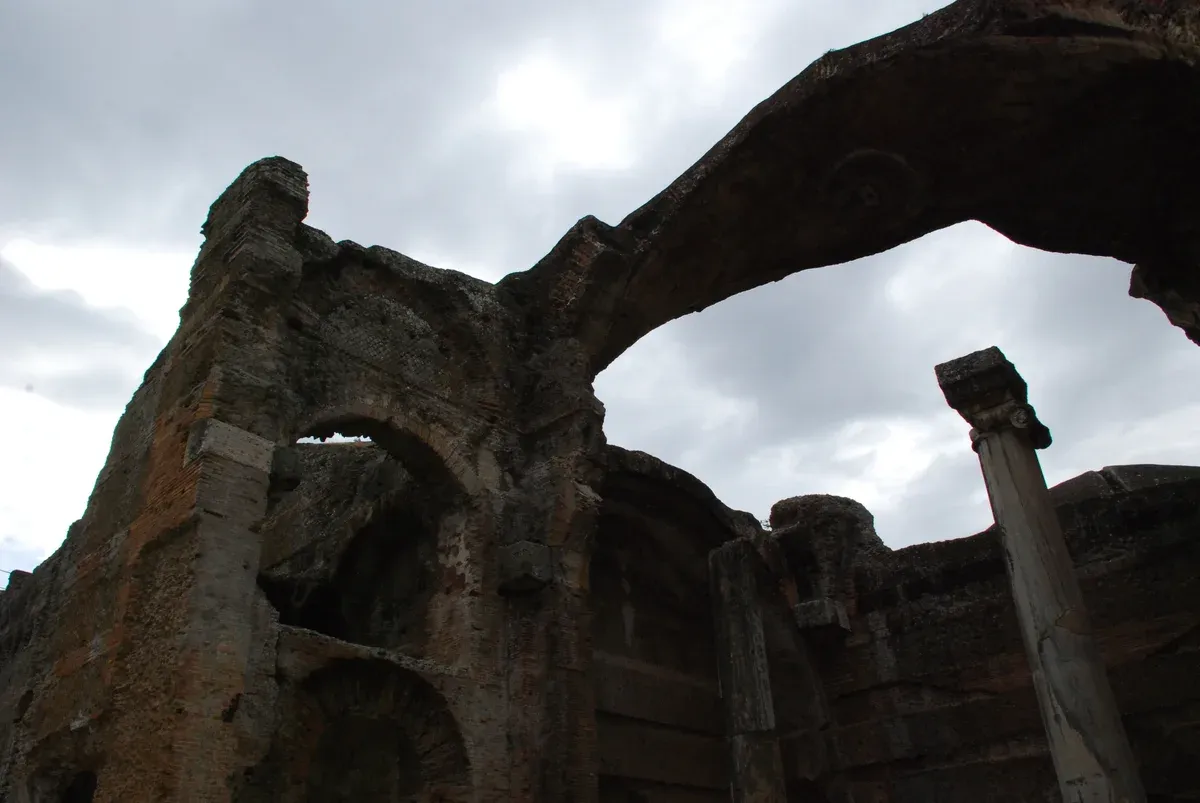
The brick vaults of the bath complex. Photo: Camelia.boban, CC BY-SA 3.0, via Wikimedia Commons
The Great Baths
The Grandi Terme, the Great Baths, are the public-scale bathing block of the villa, far bigger than the Small Baths and built to serve the whole household and its guests. You walk through the sequence of cold, warm and hot rooms as bare brick skeletons, with the double floors and wall cavities that carried the hot air still visible in places. Bathing was the social routine of a Roman day, and at Hadrian's Villa it happened at monumental scale.
The Great Baths are one of the areas that can be affected when private events interrupt the normal route, so if you arrive and find fencing across the entrance, continue toward the Canopus, which is the highlight of any visit.
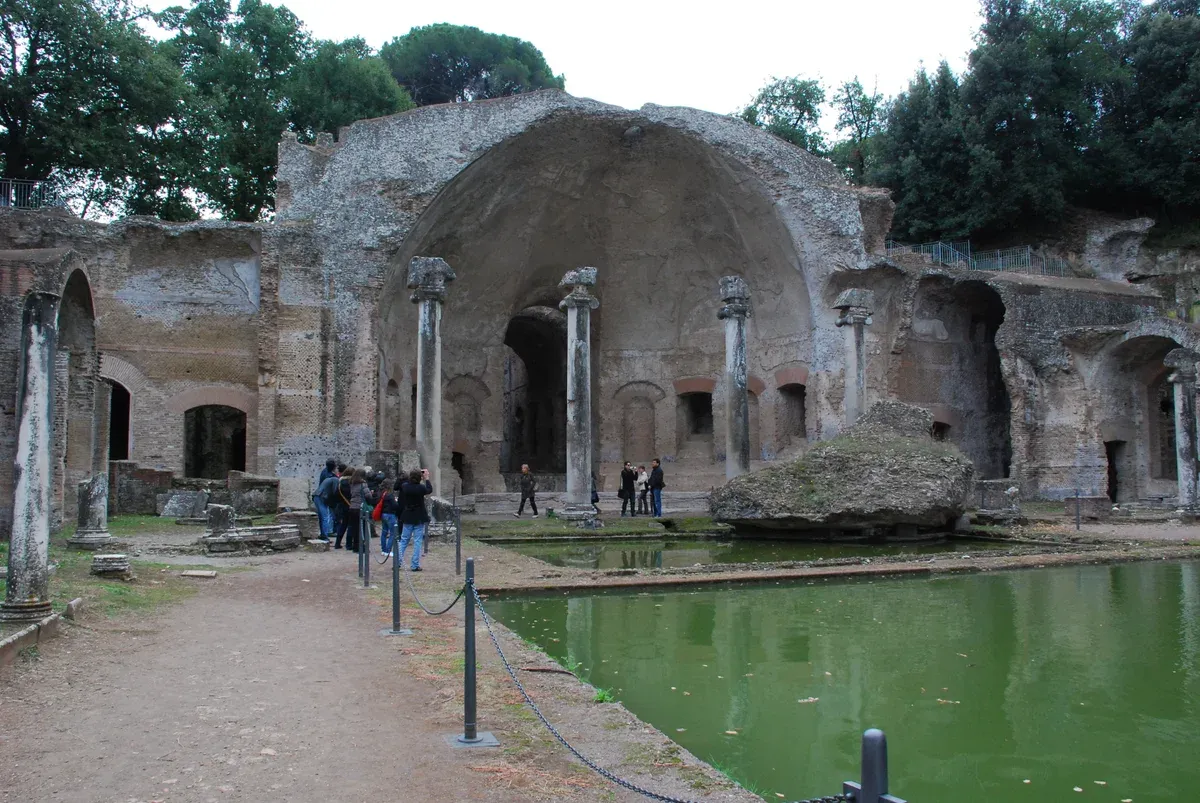
The Serapeum seen across the Canopus pool from its far end. Photo: Camelia.boban, CC BY-SA 3.0, via Wikimedia Commons
The Canopus and Serapeum
The Canopus is the signature sight of Hadrian's Villa and the reason many people come. It is a long reflecting pool, 119 metres long and 18 metres wide, recalling the canal of the same name that linked Alexandria to the Nile. At its far end sits the Serapeum, a covered banqueting hall inside an enormous domed exedra.
The sculpture line along the pool includes copies of the Erechtheion caryatids from Athens and a crocodile, an unmistakable nod to Egypt. The original caryatids are now protected in the site museum. A water triclinium found in 2021 is seen as the model for the Serapeum.
Give this area time, it is the best place on the site to sit and imagine the villa whole.
The Canopus Museums (Antiquarium)
Finish indoors at the museum section near the Canopus. The Antiquarium of the Canopus has become the Musei del Canopo, the Canopus museums, set in an 18th-century former Jesuit building on Hadrianic ruins. It reopened to the public with eight rooms displaying finds from the excavations, including four Pentelic marble caryatids with Doric capitals, a crocodile fountain, statues of the Nile and the Tiber, imperial portraits, a Horus and a Sphinx.
Seeing the actual caryatids here, after walking past their positions along the pool, closes the loop of the visit. The museum follows the same hours as the archaeological site, opening from 09:00 in summer within the site's opening window.
Sources: Lazio Nascosto, Wikipedia
Hadrian's Villa in Tivoli: the Biggest Imperial Palace of Ancient Rome
A guided walk through Hadrian's Villa, from the Pecile to the Canopus, with the history of each area. Third-party video by Live Virtual Guide. This site did not shoot it and has no relationship with the creator.
Tickets, Hours and the Free Sunday
There are several ways to pay for Hadrian's Villa, and the right one depends on how many Tivoli sites you plan to see. The figures below cover the Villae Pass and the discounts that apply at Villa Adriana.
Which Ticket to Buy
The simplest choice for most visitors is the Villae Pass at €30, which gives one entry each to Hadrian's Villa, Villa d'Este and the Santuario di Ercole Vincitore within 72 hours of first use. Sources disagree on the price of a single Hadrian's Villa ticket, so no single entry price is quoted here and the pass is the safer choice. If you arrive by train, keep your validated Trenitalia regional ticket used the same day to reach Tivoli or Bagni di Tivoli, because it gives €2 off a full Hadrian's Villa ticket under the Trenitalia agreement.
| Ticket | Price | Note |
|---|---|---|
| Villae Pass | €30 | One entry each to Hadrian's Villa, Villa d'Este and Santuario di Ercole Vincitore within 72 hours of first entry |
| EU citizens 18 to 25 | €2 | Reduced entry on presentation of ID at Villa Adriana |
| EU citizens under 18 | Free | Year round at all Villae sites, children 0 to 5 also free |
| Same-day Trenitalia discount | €2 off | Show a validated regional ticket used that day to reach Bagni di Tivoli or Tivoli station |
| First Sunday of the month | Free | Domenica al museo, no booking needed but expect crowds between 10:30 and 15:30 |
Hours, Closures and Last Entry
Villa Adriana opens daily at 08:30, and unlike Villa d'Este there is no Monday morning closure. Summer hours run 08:30 to 19:30 with last entry at 18:00. From October 25 entry runs 08:30 to 16:00 with exit by 17:30, and in November and December entry runs 08:30 to 15:30 with exit by 17:00.
Last entry is 90 minutes before closing. The site closes only on January 1 and December 25. Evening openings have been held on some summer dates, and the first Sunday of each month is free.
Sources: Villae, iMusei di Roma
The circular Maritime Theatre with its moat and colonnade at Hadrian's Villa. Photo: Daderot, Public domain, via Wikimedia Commons
Getting to Hadrian's Villa from Rome
Hadrian's Villa sits in the hamlet of Villa Adriana, about 4 km from Tivoli town centre and about 30 km from Rome. Trains do not reach it, so every option ends with a bus, a car or your feet. The full timetables and fares are on the Rome to Tivoli page.
By Cotral Bus from Rome
Cotral buses to Tivoli leave from Ponte Mammolo, the terminus of Metro B. Which bus you catch matters more than you would think. Cotral buses running along the Via Prenestina stop about 300 metres from the Hadrian's Villa entrance at Largo Marguerite Yourcenar 1, while buses on the Via Tiburtina or the A24 stop near the hamlet of Villa Adriana and leave you with about 2 km on foot. A bus from Ponte Mammolo to Villa Adriana takes about 41 minutes, and frequency runs roughly every 10 to 30 minutes in the day.
Buy your ticket before boarding at a tabacchi, newsstand or on the Cotral app, because onboard purchase costs more and fines are heavy. A Rome-only ATAC ticket is not valid.
By Train to Tivoli, Then CAT Bus
The FL2 regional train runs from Roma Tiburtina to Tivoli, with a typical journey of about 57 minutes and the quickest runs at about 36 minutes, roughly 22 trains a day. Trenitalia and CAT sell a combined train plus bus ticket called Ville di Tivoli Link, where the bus leg costs €1.30 per trip on top of the train fare and runs from the square in front of Bagni di Tivoli station to Villa Adriana and Villa d'Este. From Tivoli station itself, take CAT bus 4 or 4X, which stops right in front of the Villa Adriana entrance in about 10 to 15 minutes.
A CAT single ticket costs €1.50 and a 24-hour pass €4.00, sold at more than 52 outlets in Tivoli and on the MooneyGo app. On weekdays line 4 runs from about 06:00 to 20:00 with gaps of 40 to 90 minutes, and on Sundays and holidays it runs only about 8 times, so check the return time before going in.
By Car, and Parking at the Site
Driving from Rome takes about 45 minutes, via the A24 (exit Tivoli or Castel Madama) or the Via Tiburtina from the GRA. From the A24 Tivoli exit, follow the Strada Maremmana Inferiore for about 2.5 km to the site. The paid car park sits at Largo Marguerite Yourcenar directly in front of the ticket office, and the sources do not state the rate.
Dedicated disabled parking is listed near the main entrance of the Villa Adriana hamlet. A taxi between Tivoli town and the villa is a practical fallback if you miss the last bus, with a ride between the two villas quoted at roughly €10 to €12.
Sources: CAT Tivoli, Tivoli Tickets
Hadrian's Villa on a Tour
Most Tivoli day tours from Rome combine Hadrian's Villa with Villa d'Este, and they differ mainly in how long they give you at each site and whether a guide, tickets or lunch are included. The table compares the tours that include Hadrian's Villa, with prices and inclusions exactly as listed.
Comparing the Tours That Include the Site
Time on site at Hadrian's Villa is the number to watch. Only some listings state it. The transfer option gives about 1.5 hours at each villa, the Gray Line half day and the Enjoy Rome and Tours About full days list a 1 hour guided visit, and the rest do not say.
The half-day coach tours compress both villas into 4 to 5 hours in total. The Tivoli Day Trip with Villa d'Este and a Farmhouse Cooking Class is the exception on this site, it skips Hadrian's Villa entirely and belongs to the Villa d'Este page.
| Tour | Price | Time at Hadrian's Villa | Guide |
|---|---|---|---|
| Villa d'Este and Hadrian's Villa Tivoli Day Tour from Rome | $91 | Guided tour about 1 hour | Live guide and headsets, admission included |
| Guided Tivoli Full Day Trip from Rome to Hadrian's Villa and Villa d'Este | $97.48 | Not stated | Professional guide and headsets, admission not listed in inclusions |
| Roundtrip Tivoli Transfer from Rome with Entry Tickets to Both Villas | $84 | About 1.5 hours at each villa | No guide on site, transport and tickets only |
| Villa d'Este and Hadrian's Villa Tour from Rome with Lunch and Wine | $134 | Not stated | Live guide and headsets, admission and lunch with wine included, guided visit about 1 hour |
| Tivoli Half-Day Trip from Rome with Villa d'Este and Villa Adriana and Optional Hotel Pickup | $134 | Not stated | Bilingual guide and headsets, admission included, guided visit about 1 hour |
| Hadrian's Villa and Villa d'Este Half-Day Coach Tour from Rome | $113 | Not stated, 4 hour total | Local guide, admission to both villas included |
| Tivoli Villas Full Day Trip from Rome with Official Guide and Optional Lunch | $108.95 | Not stated | Official live guide, tickets handed out on the day |
| Tivoli Half Day Tour from Rome with Hotel Pickup, Small Group or Private | $307.35 (check which option it covers) | 3 hour guided tour of the villas | Professional guide, admission and hotel pickup included |
What the Tickets on a Tour Actually Cover
Read the inclusions carefully before booking, because they are not uniform. Some tours list admission to both villas in the price, others list only transport and a guide, and at least one private car option excludes entry altogether. Lunch is never included unless the listing says so, and most tours offer it as a paid option or leave you to eat in Tivoli.
Hotel pickup exists only where stated, such as the private transfer with hotel pickup or the small-group minivan. Free cancellation of 24 hours is standard across the listings. If a guided tour inside Hadrian's Villa matters to you, confirm at booking that the guide accompanies the group through the site rather than only handling transport.
Hadrian's Villa: Dos and Don'ts
Practical advice for a site that is mostly outdoors, uneven underfoot and short of shade.
Do
- Do go early or late in summer, because heat builds from late morning on an open archaeological site with scarce shade.
- Do bring a hat, sunscreen and a full water bottle, since there are drinking fountains along the route and a small refreshment kiosk just after the ticket office but no restaurant inside.
- Do wear flat, comfortable shoes, because the terrain is uneven, mostly outdoors and includes many stairs with no ramps.
- Do start at the scale model near the entrance, because it orients you before you walk into a site of scattered ruins spread over 40 open hectares.
- Do check the CAT bus 4 or 4X return time before entering, because weekday gaps run 40 to 90 minutes and Sunday service is only about 8 runs.
Don't
- Don't attempt the walk from Tivoli town centre, because it is not practical and the official advice is to take CAT bus, the combined train and bus link, or a taxi.
- Don't arrive in the last 90 minutes before closing, because last entry is 90 minutes before closing and 2 to 3 hours is the minimum for the site.
- Don't count on finding a shaded bench whenever you need one, because shade comes only from scattered olive trees, with one rest field outside the Imperial Palace.
Hadrian's Villa: Frequently Asked Questions
Is Hadrian's Villa worth visiting?
Yes, if you care about ancient Rome beyond the centre. It is a UNESCO site since 1999, an estate of about 120 hectares, and the Canopus pool and Maritime Theatre have no equivalent in Rome itself. If you only have time for one Tivoli site and want fountains instead, compare it with Villa d'Este.
How long do you need at Hadrian's Villa?
Plan 2 to 3 hours for the quick version and 3 to 4 hours for the full visit of the roughly 40 open hectares. Guided Tivoli tours from Rome that include it range from about 1.5 hours at the site on the transfer with entry tickets to a full day.
What was Hadrian's Villa known for?
It was known as Emperor Hadrian's country palace, his official residence from about 128, filled with recreations of places he had travelled to, such as the Pecile from Athens and the Canopus from Egypt. You can see both on the walking route described on this page.
What happened to Hadrian's Villa after Hadrian?
After Hadrian's death in 138 the villa declined, and in the 16th century Cardinal Ippolito II d'Este removed much of the surviving marble and statuary to decorate his own villa in Tivoli. Much of the site is still unexcavated and large peripheral areas remain in private hands.
How do I get to Hadrian's Villa from Rome without a car?
Take the FL2 train from Roma Tiburtina to Tivoli, about 57 minutes, then CAT bus 4 or 4X from Tivoli to the entrance, about 10 to 15 minutes. Alternatively take a Cotral bus from Ponte Mammolo. The step-by-step timetables are on the Rome to Tivoli page.
How much are tickets for Hadrian's Villa?
The practical ticket is the Villae Pass at €30, covering Hadrian's Villa, Villa d'Este and the Santuario di Ercole Vincitore within 72 hours. EU visitors aged 18 to 25 pay €2, EU under-18s enter free, and the first Sunday of each month is free. Single Hadrian's Villa tickets are quoted at different prices by different sources, so the tickets section recommends the pass.